The Right KPIs for the Right People
Most KPI conversations start in the wrong place. Teams debate which metrics to track before they’ve answered a more fundamental question: who is the data actually for?
A metric that’s useful to an individual contributor is noise to an executive. A financial KPI that drives a board conversation means nothing to someone managing a task queue. When everyone is looking at the same dashboard, nobody is looking at the right one.
Here’s how we think about structuring KPI frameworks by role.
Start with the data infrastructure
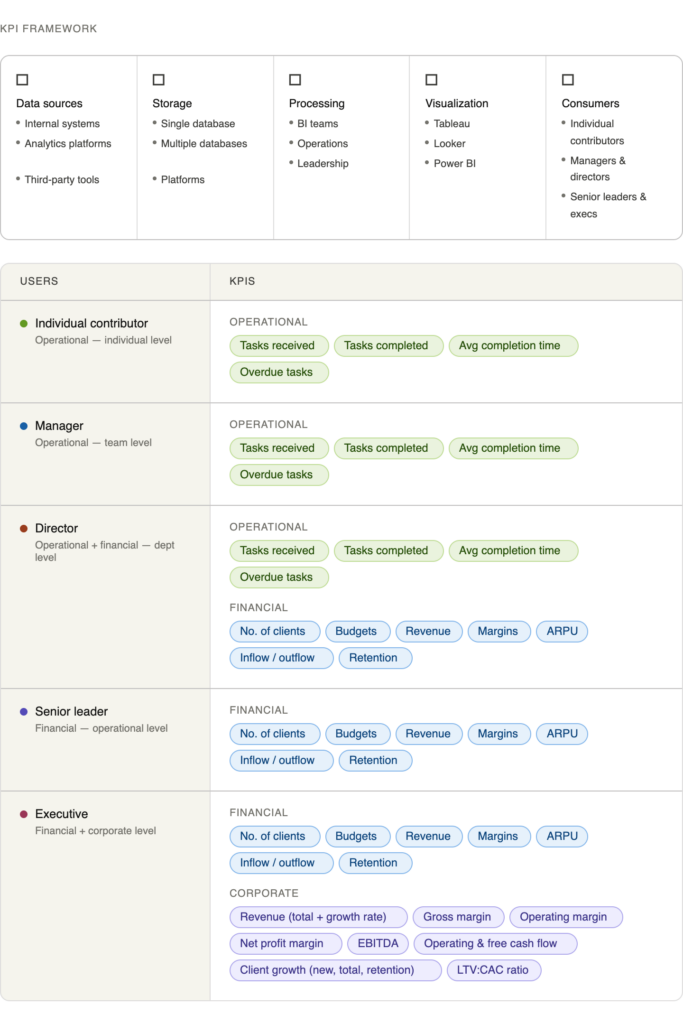
Before you can answer “what should we measure,” you need to answer “where does the data come from and how does it flow.” That means mapping your sources — internal systems, analytics platforms, third-party tools — through to storage, processing, and visualization. Whether you’re running Tableau, Looker, Power BI, or something else, the stack needs to be deliberate. Garbage in, garbage out — regardless of how good the dashboard looks.
Individual contributors: operational clarity
At the individual level, KPIs should answer one question: am I keeping up, and am I delivering on time? Tasks received, tasks completed, average completion time, and overdue tasks. That’s the full picture. Keep it simple, keep it actionable.
Managers: the same lens, wider view
Managers need the same operational metrics — just aggregated at the team level. The questions shift slightly: is the team keeping up? Where are the bottlenecks? Are we consistently hitting SLAs across the board? The metrics don’t change; the scope does.
Directors: where operations meets finance
Directors are the first level where financial KPIs enter the picture. They’re managing both delivery performance and department-level business outcomes — client counts, revenue, margins, ARPU, inflow and outflow, and retention. This is the layer where operational efficiency starts connecting to business results.
Senior leaders: financial accountability
Senior leaders step back from task-level metrics entirely. Their view is financial: how is the business performing across revenue, margins, client growth, and retention? The same core financial KPIs as directors, but framed at the operational unit level rather than a single department.
Executives: the full corporate picture
At the executive level, the KPI set expands to include corporate-level financial health — gross margin, operating margin, net profit margin, EBITDA, cash flow, and the LTV:CAC ratio. These are the numbers that tell you whether the business model itself is working, not just whether this quarter’s tasks got done.
Strong executives also understand that company performance does not happen in isolation. Broader macroeconomic trends — inflation, interest rates, labor markets, consumer spending, and global economic conditions — all influence growth, forecasting, hiring, and investment decisions.
- Explore U.S. economic data and macro trends
- Explore global economic indicators and international market data
A well-designed KPI framework isn’t just a list of metrics. It’s a set of deliberate decisions about what each level of your organization needs to see — and what they don’t. When the right data reaches the right people, decisions get faster, accountability gets clearer, and the whole organization moves in the same direction.