What to Actually Expect from SEO (And When)
SEO gets oversold. You’ve probably heard some version of “it takes time” without ever getting a straight answer on what that means. So here it is.
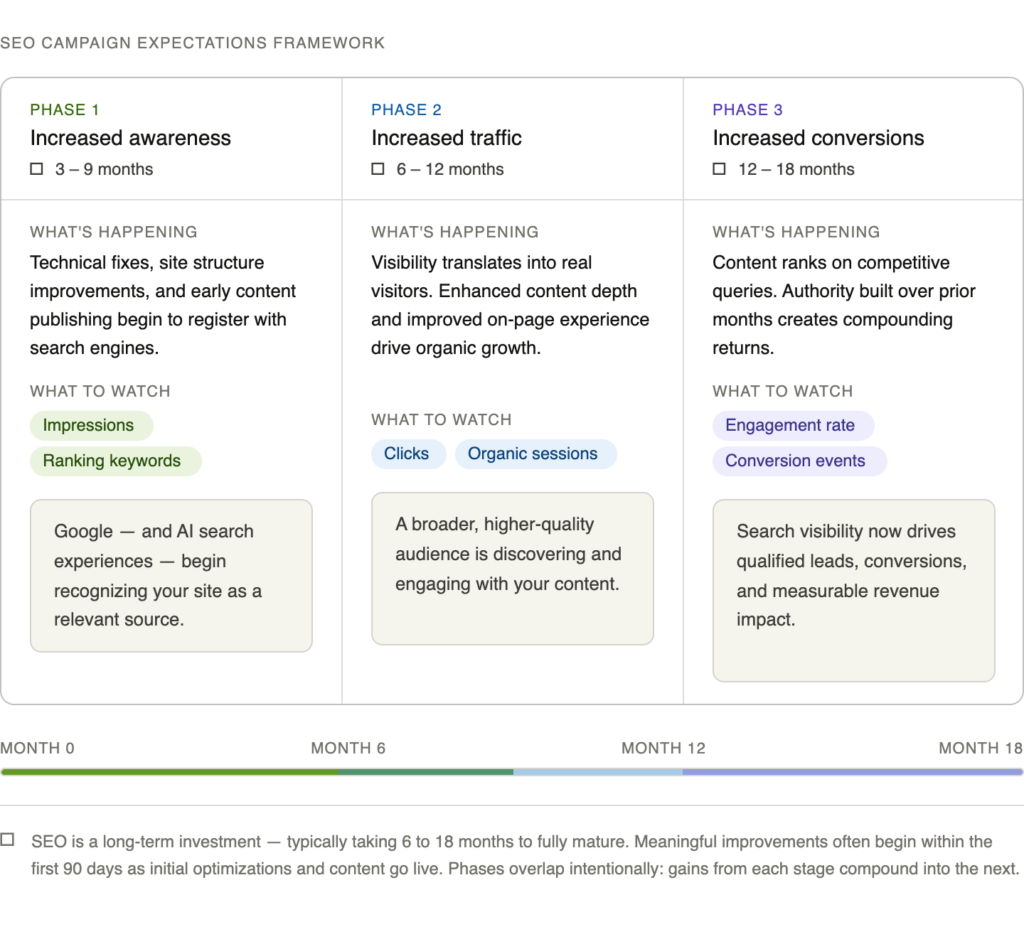
A well-executed SEO campaign follows a predictable arc. It doesn’t happen overnight, and it doesn’t happen randomly. There are three distinct phases, each building on the last — and if you know what to watch for in each one, you can tell whether your investment is working long before revenue starts moving.
Phase 1: Increased awareness (months 3–9)
This is the foundation phase. Technical issues get resolved, site structure gets cleaned up, and content starts going live. Nothing flashy — but it matters enormously.
What you’ll see: impressions climbing and your total ranking keywords growing. Your site starts appearing in search results it wasn’t showing up in before. Google — and increasingly, AI-powered search experiences — begins recognizing you as a relevant source in your space.
If impressions and keyword counts aren’t moving after 90 days, something is wrong. That’s your early warning signal.
Phase 2: Increased traffic (months 6–12)
Visibility alone doesn’t pay the bills. Phase 2 is where it starts translating into actual visitors.
Better content depth, a technically sound site, and improved on-page experience combine to move you up the rankings on queries that matter. Organic clicks and sessions grow. The audience reaching your site is broader and more qualified than it was before.
This is also where the compounding effect of Phase 1 becomes visible. The groundwork you laid doesn’t disappear — it starts paying interest.
Phase 3: Increased conversions (months 12–18)
By month 12, you’re competing for and winning on higher-intent, more competitive queries. The authority your site has built over the previous year starts to work in your favor in a way that’s hard to replicate quickly.
What to track here: engagement rate and conversion events. Not just traffic — what that traffic is doing. At this stage, SEO stops being a visibility play and becomes a genuine revenue channel. Qualified leads, demo requests, purchases — the outcomes that justify the investment.
Why this matters
SEO isn’t a tactic you turn on and off. It’s an asset that compounds. The businesses that treat it that way — committing to the full lifecycle rather than expecting shortcuts — are the ones that end up with a durable, defensible growth channel.
The framework above gives you a map. Use it to set expectations internally, benchmark progress at each stage, and make confident decisions about where you are in the process.