AEO programs rarely fail on content; they fail because nobody can say what is changing, who owns it, and how it is measured. This post lays out an operating model that moves from diagnosis to measured iteration across three levels: OKR, KPI and roadmap.
Ambiguity is a visibility risk
When an AI system cannot tell what your brand is, who it serves or how it differs, it does not rank you lower. It leaves you out of the answer. That makes ambiguity the first thing to diagnose, in the organization as much as on the website.
I start every program with three questions:
- Why are we here?
- How did we get here?
- What do we do now?
A team that cannot answer the first two will guess at the third. In this model a strategy is a hypothesis, an educated guess, and the operating model exists to make that guess testable. The rest of this post is the machinery for doing that.
The working rule behind it is the one on my wall: don’t think you are visible, know you are. Belief is not a measurement.
What is changing, what is not, and the 80/20
AEO and GEO change where exposure happens, not what earns it. Separating the two stops a team from rebuilding things that still work.
| What is changing | What is not | |
|---|---|---|
| Unit of exposure | A cited or recommended answer, not a ranked link | A person with an intent and a decision to make |
| What gets selected | Sources a model can parse, trust and compare | Quality, authority and relevance |
| The page | One input among many to a synthesized response | Crawlability, indexability and site health |
| The measure | Visibility, sentiment, citations and referrals | Revenue, conversion and cost of acquisition |
The 80/20 follows from that split. Three levers carry most of the work: content, prominence, and schema plus technical health. Everything else is a candidate for the backlog until the diagnosis says otherwise. The discipline is saying no to the other 80 percent of ideas long enough to measure the three that matter.
The operating loop
One loop runs the whole program, and every turn of it reads from and writes to three levels.
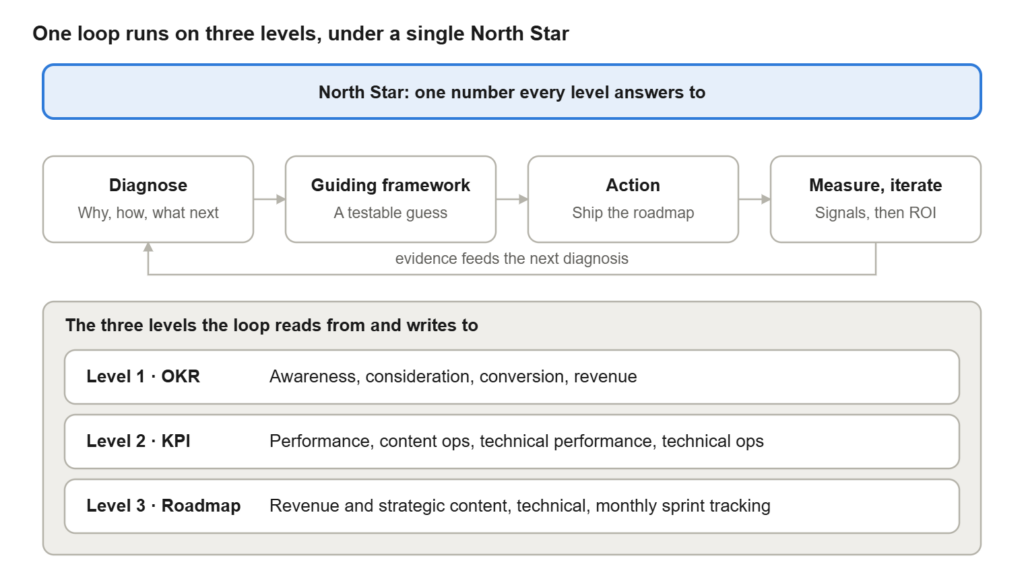
Diagnose first, then set a guiding framework you are willing to be wrong about, then act, then measure and feed the evidence back into the next diagnosis. The levels keep each turn honest: the North Star sets direction, and the OKR, KPI and roadmap say what to check and what to ship.
Three levels of control
The model runs on three levels, each answering a different question for a different reader. Mixing them is how dashboards become unreadable and roadmaps become wish lists.
| Level | Instrument | Question it answers | What it contains |
|---|---|---|---|
| 1 | OKR | Is the program moving the business? | Awareness, consideration, conversion, revenue |
| 2 | KPI | Is the machine healthy? | Performance, content ops, technical performance, technical ops |
| 3 | Roadmap | What ships next, and did it ship? | Revenue and strategic content, technical work, monthly sprint tracking |
Level 1 is the overview an executive reads. Level 2 splits into the two engines that produce the results: revenue and strategic content on one side, technical on the other. Level 3 is the monthly sprint record that connects a piece of work to a Level 2 movement and, through it, to a Level 1 outcome.
Over all three sits a North Star: one number every level has to answer to. [Open question for you: your wall says 30%. Which metric is that, and over what period?]
Content that earns the answer
Content wins an AI answer by being complete, not by being long. The test I apply to every page is a rule on the wall: no partial answers.
A page that earns the answer does five things:
- Defines the thing in plain words
- Explains how it works
- Compares it with the alternatives a reader is weighing
- Addresses its own limitations honestly
- Resolves the follow-up questions before the reader has to ask them
The first three make a page citable. The last two make it trustworthy, and trust is what a model leans on when several sources agree on the basics.
Content is one of three levers. The second is prominence: whether the wider web describes your brand the same way you do. The third is schema and technical health, which decide whether a machine can read what you wrote. All three feed one question worth asking every quarter: how well is your brand understood? If you cannot answer it with evidence, you are back at the first section.
Measuring AI visibility, then proving ROI
Four signals tell you whether AI systems know you, and a data pipeline tells you whether it mattered. Track the signals alone and you get a vanity report. Track revenue alone and you cannot see the cause.
| Signal | Question it answers | Business stage it informs |
|---|---|---|
| Visibility | Do we appear in answers for the prompts that matter? | Awareness |
| Sentiment | How are we described when we do appear? | Consideration |
| Citations | Which of our pages are used as sources? | Consideration |
| Referrals | Do answers send visits that convert? | Conversion and revenue |
The ROI case rests on three commitments. Cover the full funnel, not just the last click. Settle attribution rules before the numbers arrive, so nobody argues about method after a result they dislike. And build the data pipeline early, because a metric you cannot trace to its source is an opinion.
That last point is also what earns a senior reader’s trust. Every number in the Level 1 view should be able to show where it came from.
Technical SEO is the periodic table
Technical SEO is the periodic table of this model: a small set of stable elements, grouped by behavior, that combine into everything an AI answer needs.
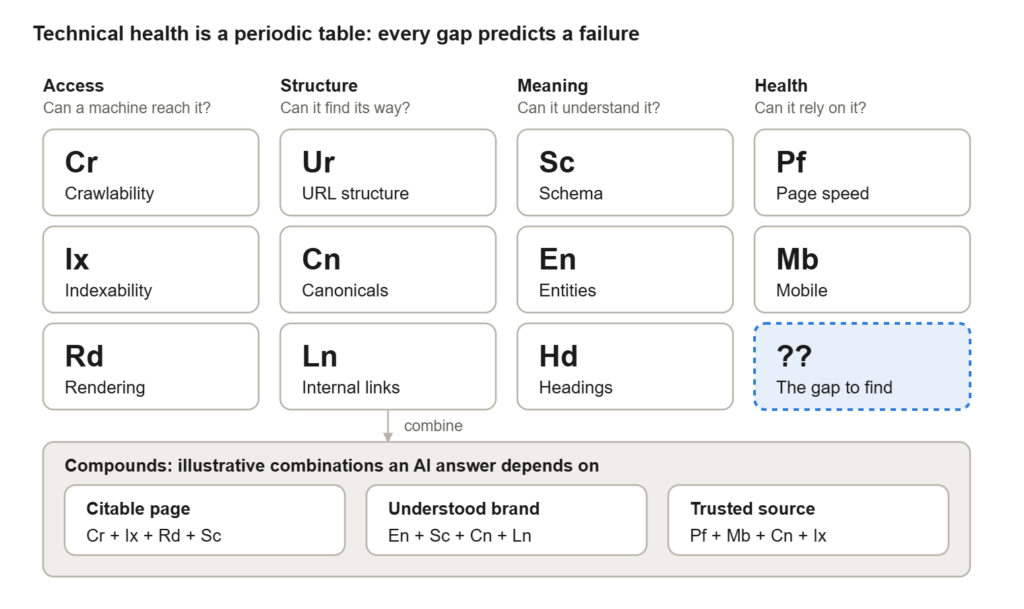
Two ideas carry over from chemistry. First, compounds fail when one element is missing: a page with perfect schema still disappears if rendering hides its content. Second, Mendeleev left gaps in his table and predicted what would fill them. A good technical audit does the same. The element you have not measured is where the next failure will come from, which is why schema and technical health sit beside content and prominence as one of the three levers.
Run it as a product, with a team that can
AEO becomes durable when it is run as a product with six-month strategy cycles, three workflows and people who are growing. A campaign mindset produces a spike. A product mindset produces a compounding asset.
The product has three pillars, each with its own owner and queue:
- Research and strategy: the diagnosis, the hypotheses, the prompt universe
- Content workflow: briefs, drafts, review and refresh against the no-partial-answers standard
- Technical workflow: schema, rendering, crawl and index health
Cross-functional work decides whether any of it ships. Three habits carry it: seek alignment before asking for work, listen to understand the other team’s constraint, and frame every request as a trade-off with a cost on both sides. Success is judged on four things at once: quality, volume, speed and a stable pipeline. Optimizing one at the expense of the others is a signal to renegotiate the plan.
Inside the team, the principles are short: high standards, agile cycles, transparency about effort and impact, protected time for deep work, and deliberate development of each person. The model scales only as far as the people running it do.
Where this leaves a leader, and what to do Monday
AEO is one domain where a leader has to coordinate people, goals and resources, which is the job any operating model exists to structure. The loop in this post is the same flow a leader runs anywhere: diagnose where you are, set a guiding framework, act, then measure and iterate. AEO makes the loop unusually visible because the feedback arrives in the answers themselves.
Three moves put it to work this week:
- Write down your answers to the three opening questions, and have one other person do it independently. Where the answers differ, you have found your first ambiguity.
- Choose the Level 1 outcomes and the North Star. Then trace each to a Level 2 KPI, so no metric floats without an owner.
- Audit ten pages against the no-partial-answers standard, and run the four visibility signals once as a baseline.
Then do not think you are visible. Know you are.
For the wider operating-model thinking behind this, see Leader Atlas.
