How We Set Goals That Actually Get Executed
Most goal-setting fails at the same point: the gap between what leadership decides in a planning session and what actually changes on the ground. Objectives get written, shared once, and quietly forgotten by February.
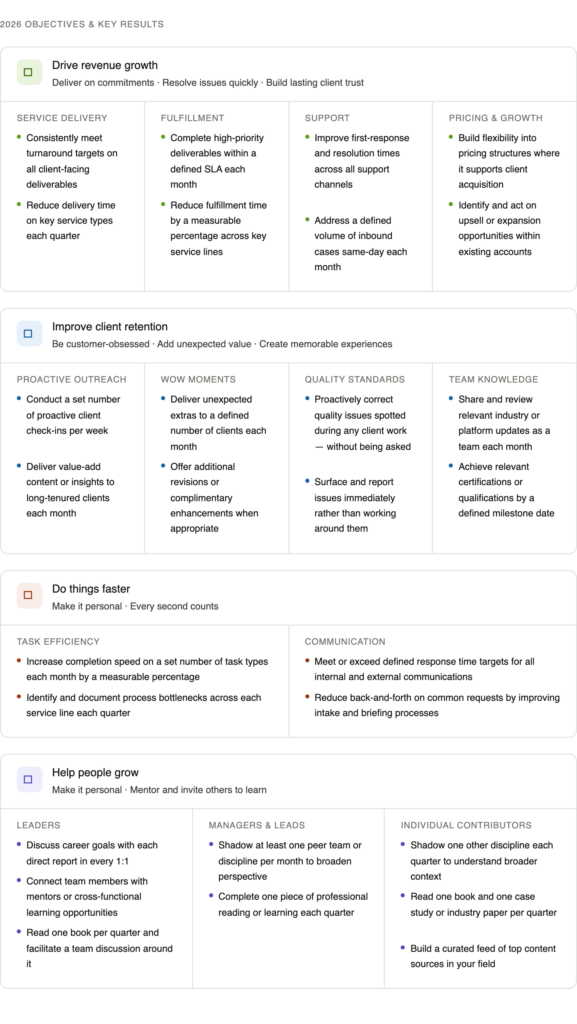
We do it differently. Our annual OKRs are built around four objectives that connect directly to day-to-day work — not abstract ideals. Each one has specific, measurable key results tied to it, broken down by role and team so there’s no ambiguity about who owns what.
Here’s how we think about each one.
Drive revenue growth by delivering on your commitments
The fastest path to revenue growth isn’t a better pitch. It’s reliability. When clients know you’ll deliver what you promised, on time, every time, renewals and referrals follow naturally. Our revenue OKRs focus on turnaround times, fulfillment speed, and same-day case resolution — the operational fundamentals that clients notice and remember.
The principle: speed and consistency are competitive advantages, not just operational metrics.
Improve retention by adding value no one asked for
Retention isn’t won at renewal time. It’s built in hundreds of small moments over the course of the year — a proactive check-in before a client raises a concern, a deliverable that goes slightly beyond scope, a quality issue corrected without being asked. Our retention OKRs make those moments deliberate and trackable: a defined number of client check-ins per week, value-add content delivered to long-term clients monthly, unexpected extras built into standard workflows.
The principle: the clients who stay longest aren’t just satisfied — they feel genuinely looked after.
Do things faster — and make it personal
Speed is a form of respect. When you respond quickly, deliver ahead of schedule, and remove friction from every interaction, you’re telling clients and colleagues that their time matters. Our speed OKRs are intentionally personal: each person is responsible for identifying where they can move faster and improving their own processes — not just waiting for a system to change.
The principle: every second counts, and that starts with the individual.
Invest in your people — at every level
Growth doesn’t happen by accident. Leaders ask about career goals in every 1:1. Managers shadow peer teams to understand the broader product ecosystem. Individual contributors read industry papers, build curated knowledge feeds, and cross-pollinate with other disciplines. These aren’t suggestions — they’re key results, tracked like everything else.
The principle: the team that keeps learning is the team that keeps winning.
OKRs work when they’re honest, specific, and lived — not filed away after the planning quarter. Ours are designed to be referenced weekly, reviewed monthly, and owned at every level of the organization. That’s the difference between a goal and a growth plan.